The first Antarctic expeditions marked a period of exploration and discovery in the late 19th and early 20th centuries, as explorers sought to unlock the mysteries of the frozen continent. Here are some key expeditions that played a crucial role in Antarctic exploration:
- James Cook’s Second Voyage (1772-1775): Captain James Cook was one of the first to cross the Antarctic Circle during his second voyage. Although he did not sight Antarctica, his exploration of the Southern Ocean contributed to the understanding of the region’s geography and climate. Technology: Sailing ships were the primary means of transportation during Cook’s time. Navigation relied on basic instruments like the sextant and compass. Cook’s voyages significantly improved marine chronometers for accurate timekeeping at sea. Cook’s ship, HMS Resolution, was approximately 111 feet (34 meters) long.
- Antarctic Peninsula Exploration (1819-1820): The early 19th century saw explorers like William Smith and Edward Bransfield discovering parts of the Antarctic Peninsula. Their expeditions were important in laying the groundwork for future exploration. Technology: Sailing ships were still the primary mode of transport. Navigation instruments had improved since Cook’s time, but exploration equipment remained limited. Expeditions relied on traditional mapping techniques and visual observation. The ships used by explorers like William Smith and Edward Bransfield were typically smaller, ranging from 50 to 70 feet (15 to 21 meters).
- James Clark Ross’s Antarctic Expedition (1839-1843): Ross led an expedition that included the discovery of the Ross Sea and the Ross Ice Shelf. He also located the magnetic South Pole during this voyage. His contributions significantly expanded knowledge of Antarctic geography. Technology: Ross utilized steam-powered ships, HMS Erebus and HMS Terror, for the first time in Antarctic exploration. This technology enabled better maneuverability and navigation in icy waters. Improved magnetic instruments were used for mapping and scientific observations. HMS Erebus and HMS Terror, used by Ross, were both Royal Navy bomb vessels and measured around 105 feet (32 meters) in length.
- Carsten Borchgrevink’s Southern Cross Expedition (1898-1900): Borchgrevink’s expedition was the first to spend an entire winter on the Antarctic continent. They established a winter quarters at Cape Adare and conducted scientific observations, providing valuable data on the region’s meteorology and wildlife. Technology: Steamships continued to be crucial. Borchgrevink’s expedition made use of newly developed cold-weather gear, allowing for more extended stays in Antarctica. Basic meteorological instruments and photographic equipment were employed for scientific observations. Southern Cross, the ship used by Borchgrevink, was a steamship and measured approximately 150 feet (46 meters) in length.
- Robert Falcon Scott’s Discovery Expedition (1901-1904): Scott led this British expedition, which aimed to explore regions adjacent to the Ross Sea. Although they made significant scientific contributions, the expedition was also notable for the hardships faced, including the loss of their ship, the Discovery. Technology: The Discovery Expedition saw the use of sledges, ponies, and dogs for overland travel. Scientific instruments included improved meteorological tools and early photographic equipment. The expedition faced challenges due to the limitations of technology, including the loss of the Discovery in the ice. The Discovery, the ship used by Scott, was a barque and measured about 170 feet (52 meters) in length.
- Ernest Shackleton’s Nimrod Expedition (1907-1909): Shackleton’s expedition aimed to reach the South Pole, and although they fell short, they set a new Farthest South record. The expedition showcased Shackleton’s leadership skills and determination, laying the foundation for his later expeditions. Technology: The expedition employed a combination of ship, ponies, and sledges. Improved clothing technology and food supplies enhanced the team’s chances of survival. Early motor vehicles were used, but they proved unreliable in the harsh conditions. Nimrod, Shackleton’s ship, was a barquentine and measured around 200 feet (61 meters) in length.
- Amundsen and Scott’s Race to the South Pole (1911-1912): Norwegian Roald Amundsen and British Captain Robert Falcon Scott separately raced to be the first to reach the South Pole. Amundsen’s team succeeded in December 1911, while Scott’s team tragically perished on their return journey in 1912. Technology: Both expeditions utilized a mix of traditional sledges, dogs, and ponies for transportation. Scott’s team experimented with motorized sledges, but they were not practical. Technological limitations, such as inadequate clothing and nutrition, contributed to the tragic outcome for Scott’s team. Amundsen’s ship, Fram, was a wooden three-masted schooner and measured approximately 128 feet (39 meters) in length. Scott’s Terra Nova was a steamship-barque, around 187 feet (57 meters) long.
- Imperial Trans-Antarctic Expedition (1914-1917):
- Led by Sir Ernest Shackleton, this expedition aimed to cross the Antarctic continent from one side to the other via the South Pole. However, the expedition’s ship, the Endurance, became trapped in the ice and eventually sank. Shackleton and his crew endured incredible hardships but managed to survive. The ship “Endurance” was a three-masted barquentine with a length of approximately 144 feet (44 meters). It was equipped with modern navigational instruments for its time, including a Marconi wireless telegraph for communication.
- First Australasian Antarctic Expedition (1911-1914):
- Led by Australian geologist Sir Douglas Mawson, this expedition focused on scientific research and exploration of East Antarctica. Mawson’s team conducted extensive studies in geology, meteorology, and biology, making important contributions to Antarctic knowledge. The main ship, the “Aurora,” was a steam yacht with a length of about 187 feet (57 meters). It was equipped with wireless communication and carried a seaplane, which was one of the first instances of aircraft used in Antarctic exploration.
- Ross Sea Party (1914-1917):
- This was a part of Sir Ernest Shackleton’s Imperial Trans-Antarctic Expedition. The Ross Sea Party, led by Aeneas Mackintosh, was tasked with laying supply depots for Shackleton’s crossing party. The group faced extreme challenges, and not all members survived. The expedition utilized the ship “Norvegia,” a sealing and whaling vessel with a length of around 185 feet (56 meters). While not as technologically advanced as later expeditions, it had equipment for oceanographic and meteorological studies.
- Norwegian-British-Swedish Antarctic Expedition (1929-1930):
- Led by Norwegian explorer Nils Larsen, this expedition focused on exploring and mapping areas of Antarctica near the Weddell Sea. The Swedish and British participants contributed to scientific research in various fields. Admiral Byrd’s flagship, the “Bear of Oakland,” was an aircraft carrier converted into an exploration vessel with a length of approximately 330 feet (100 meters). It featured aircraft for aerial exploration and mapping, as well as scientific instruments for various studies.
- Second Byrd Antarctic Expedition (1933-1935):
- Led by Admiral Richard E. Byrd of the United States, this expedition aimed to explore and map regions of Antarctica, focusing on the area surrounding the Rockefeller Mountains. Byrd conducted numerous flights over the continent and established the base “Little America II.”
- British Graham Land Expedition (1934-1937):
- Led by John Rymill, this expedition focused on exploring and mapping the Graham Land region of the Antarctic Peninsula. The team conducted geological, biological, and meteorological studies during their expedition. The expedition’s ship, the “Penola,” was a sealer and supply ship with a length of about 164 feet (50 meters). While not as large as some other vessels, it was well-equipped with scientific instruments for geological and biological research.
- The German Antarctic Expedition(1938-1939), led by Captain Alfred Ritscher, stands as a remarkable and multifaceted scientific endeavor backed by the technological prowess of Nazi Germany before World War II. At the heart of the expedition was the MS Schwabenland, a flagship vessel measuring approximately 148 meters in length. This advanced catapult ship housed a Dornier Wal seaplane, which played a pivotal role in the expedition’s success by facilitating aerial surveys and mapping of the Antarctic coastline. The technological sophistication of the Schwabenland included cutting-edge navigation and communication systems, crucial for navigating the challenging Antarctic environment. Accompanying the flagship was the support vessel New Swabia, responsible for transporting supplies, equipment, and personnel, ensuring the logistical support necessary for scientific exploration in the harsh conditions of Antarctica. The expedition encompassed a range of scientific disciplines, conducting comprehensive surveys in meteorology, geophysics, biology, and cartography. Despite its genuine scientific pursuits, the expedition’s association with Nazi Germany has led to persistent conspiracy theories and speculation about ulterior motives, with some suggesting secret military objectives. Nonetheless, the German Antarctic Expedition of 1938-1939 remains a fascinating chapter in Antarctic exploration, reflecting both the scientific ambitions and geopolitical context of its time.
While Operation Highjump took place during the post-World War II era and isn’t considered one of the first Antarctic expeditions, it played a significant role in modern Antarctic exploration. Here’s an addition to the list:
9. Operation Highjump (1946-1947): After World War II, the United States Navy organized Operation Highjump, led by Admiral Richard E. Byrd. The operation was officially titled “The United States Navy Antarctic Developments Program” and aimed to establish the United States as a major player in Antarctic research and exploration. The expedition involved a large task force, including multiple ships, aircraft, and personnel.Operation Highjump had several objectives, including mapping the coastline of Antarctica, establishing research stations, and conducting scientific experiments. The expedition marked the beginning of more systematic and organized exploration in the region. Despite encountering logistical challenges and the harsh Antarctic environment, Operation Highjump contributed valuable data and insights into the continent.The expedition laid the groundwork for subsequent U.S. Antarctic activities and set the stage for the International Geophysical Year (IGY) in 1957-1958, which further intensified global scientific collaboration in Antarctica. Operation Highjump, with its focus on both military and scientific goals, is a noteworthy chapter in the history of Antarctic exploration during the mid-20th century. Technology: Operation Highjump marked a shift towards more modern technology. Aircraft, including helicopters, were extensively used for reconnaissance and transport. The expedition benefited from advances in communication technology, such as radio, facilitating better coordination among the various task force elements. The flagship of Operation Highjump, USS Mount Olympus, was an icebreaker and measured about 390 feet (119 meters) in length.
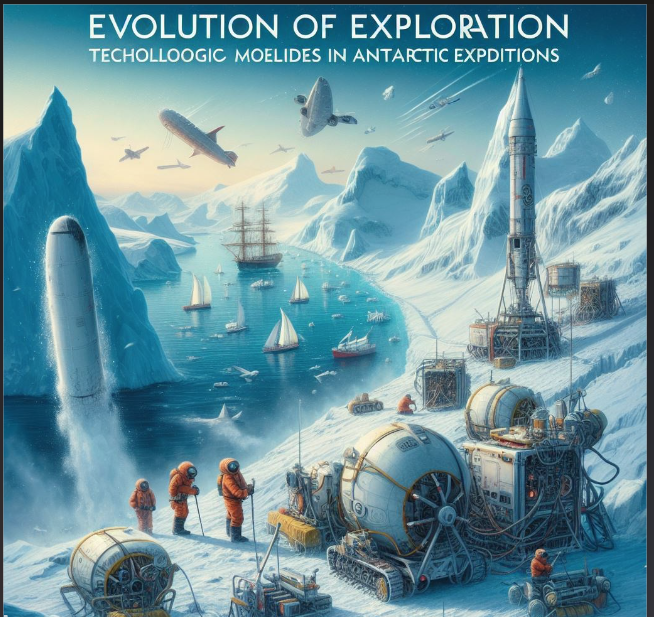
In Conclusion: These early expeditions laid the groundwork for subsequent exploration and scientific research in Antarctica. These expeditions marked a transition from traditional sailing vessels to more technologically advanced ships, incorporating wireless communication, aircraft, and specialized scientific equipment. The use of modern technology during these explorations contributed significantly to the scientific findings and overall success of the expeditions. The challenges faced by these pioneers, including harsh weather conditions, isolation, and limited resources, are a testament to the resilience and determination of those who sought to unravel the secrets of the southernmost continent.