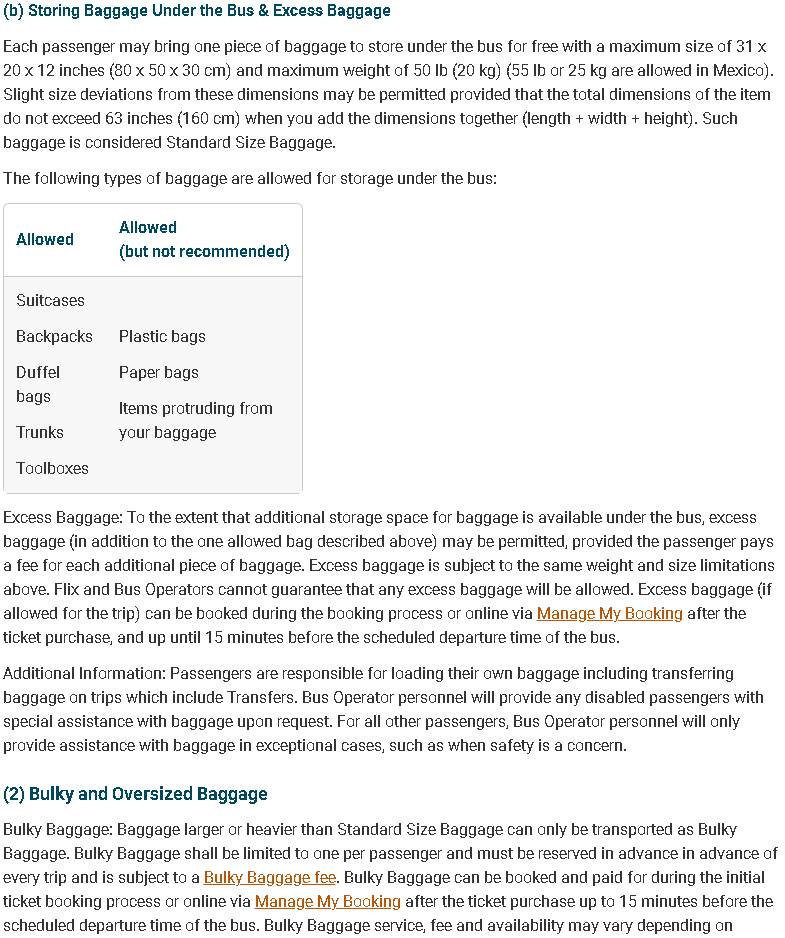
Your Greyhound ticket comes with complimentary baggage transport. In North America (excluding Mexico) and internationally, you’re allowed one carry-on bag, which should fit under your seat or in the overhead compartment, and one stored bag, to be placed in the baggage compartment before boarding. Ensure your bag has your contact details both inside and out, and it’s recommended to label it clearly with your name, address, and phone number. For international trips to Mexico, the allowance increases to one carry-on bag and two stored bags.
It’s important to pack your belongings securely to prevent damage or loss. Greyhound suggests avoiding certain types of baggage, such as plastic or paper bags, and items protruding from your luggage.
Regarding excess baggage, the number of additional bags allowed depends on available space in the baggage compartment. Excess baggage must be booked and paid for online before departure.
For bulky baggage, each passenger can bring one item, with dimensions limited to a maximum of 95 inches. Booking and payment for bulky baggage can be done online, via the app, or at staffed station locations.
Strollers and car seats can be brought onboard at no additional cost, in addition to your regular baggage allowance. Similarly, passengers with wheelchairs or walking aids should refer to the Customers with Disabilities page for details.
Special items like bicycles, golf clubs, skis, and ski poles are considered bulky and must be securely packed in substantial containers. Additional charges may apply.
Passengers are responsible for collecting their baggage upon arrival and transferring it to their next bus if necessary. Greyhound offers assistance if needed.

Is it a single trip to a destination or are you traveling to and riding in multiple different places?
I have not traveled by bus with a bike. I have traveled by air with a bike. We use Pika Packworks soft cases. They’re stout and well padded, but we still put a fair amount of effort into disassembly of the bike and padding everything with foam tubes. That helps but doesn’t guarantee there will be no damage.
It’s a trade-off. Soft cases are a lot lighter and less bulky to deal with than hard cases, but don’t offer the same protection, though bikes can get damaged in hard cases too.
Our cases fit road bikes but also FS mtbs when we take the fork off the bike. The bigger the bike, the more disassembly is required to fit it into a reasonably sized case/box. Your bikes are larger and heavier than many bikes so will be more of a challenge. You might go to a dealer and see if you can get a box that model was shipped in and disassemble and pack them the same way they were originally shipped. That’s going to be big and bulky. Also, new boxed bikes are shipped with the boxes standing upright. When they put bikes on a bus or plane, they lay them down on the side and might stack stuff on top which has more potential for damage.
Me, I’d lean towards a hard case for this.
Simply because the people loading baggage onto the bus WILL lay the case on its side, and they WILL stack things on top. Probably not so carefully.
But the space limitations for hard cases are going to make it hard to fit your bikes. The cruiser and townie are probably out of question. I can’t find any bike called a “Giant Santiago” so I’m not sure what it is, and whether it would fit into a hard case better.
In case of lost baggage, Greyhound will assist in locating it, though they do not hold liability for any losses. For baggage found within the Contiguous United States, Greyhound can arrange to send it back. Otherwise, passengers must make their own shipping arrangements.